
Types of Healthcare Reimbursement Models: Everything You Need to Know
Healthcare reimbursement models determine how providers are paid for patient care. This guide explains fee-for-service, capitation, bundled payments, and value-based care, along with their impact on healthcare costs, patient outcomes, and provider revenue.

Did you know that U.S. healthcare spending reached nearly $4.9 trillion in 2023? As costs continue rising across the healthcare industry, providers face growing pressure to improve operational efficiency, reduce claim denials, and adapt to evolving healthcare reimbursement systems.
The different types of reimbursement in healthcare determine how hospitals, physician groups, specialists, and other healthcare providers get paid for delivering patient care. These payment structures influence everything from revenue stability and administrative workflows to patient access and long-term treatment outcomes.
As the industry continues shifting away from volume-driven care, understanding modern types of healthcare reimbursement models has become increasingly important. Traditional systems like fee-for-service still play a major role, but newer approaches such as capitation, bundled payment, and value-based reimbursement are reshaping how providers manage care delivery and financial performance.

This guide breaks down the most important types of healthcare reimbursement, explains how each model works, and explores how providers can optimize reimbursement while continuing to deliver high-quality care.
What Is Reimbursement and How Does Healthcare Reimbursement Work?
At its core, reimbursement refers to the payment healthcare organizations receive after delivering medical treatment or administrative services to patients. The healthcare reimbursement process determines how physicians, hospitals, clinics, and specialists are compensated for the care they provide.
The process usually begins when a patient receives treatment. Providers then complete billing and coding, document all services rendered, and begin submitting claims to insurers or government payers. Once reviewed, the payer determines whether to approve, partially approve, or issue a denial for the claim.
The reimbursement process influences nearly every aspect of modern healthcare, including provider staffing, operational costs, and patient access to medical treatment.
What Is Medical Reimbursement and Who Pays for Healthcare Reimbursement?
Medical reimbursement is the financial compensation paid to providers after healthcare services are delivered. Depending on the patient’s insurance coverage, payment may come from private insurance companies, employer-sponsored plans, Medicare, Medicaid, or patients themselves.
Each payer determines the approved payment amount according to contracts, coverage policies, and reimbursement schedules. Because every payer uses different methodologies, providers must navigate a highly complex reimbursement environment.
Government programs such as Medicare and Medicaid typically rely on standardized reimbursement structures, while commercial insurers often negotiate payment contracts directly with healthcare organizations.
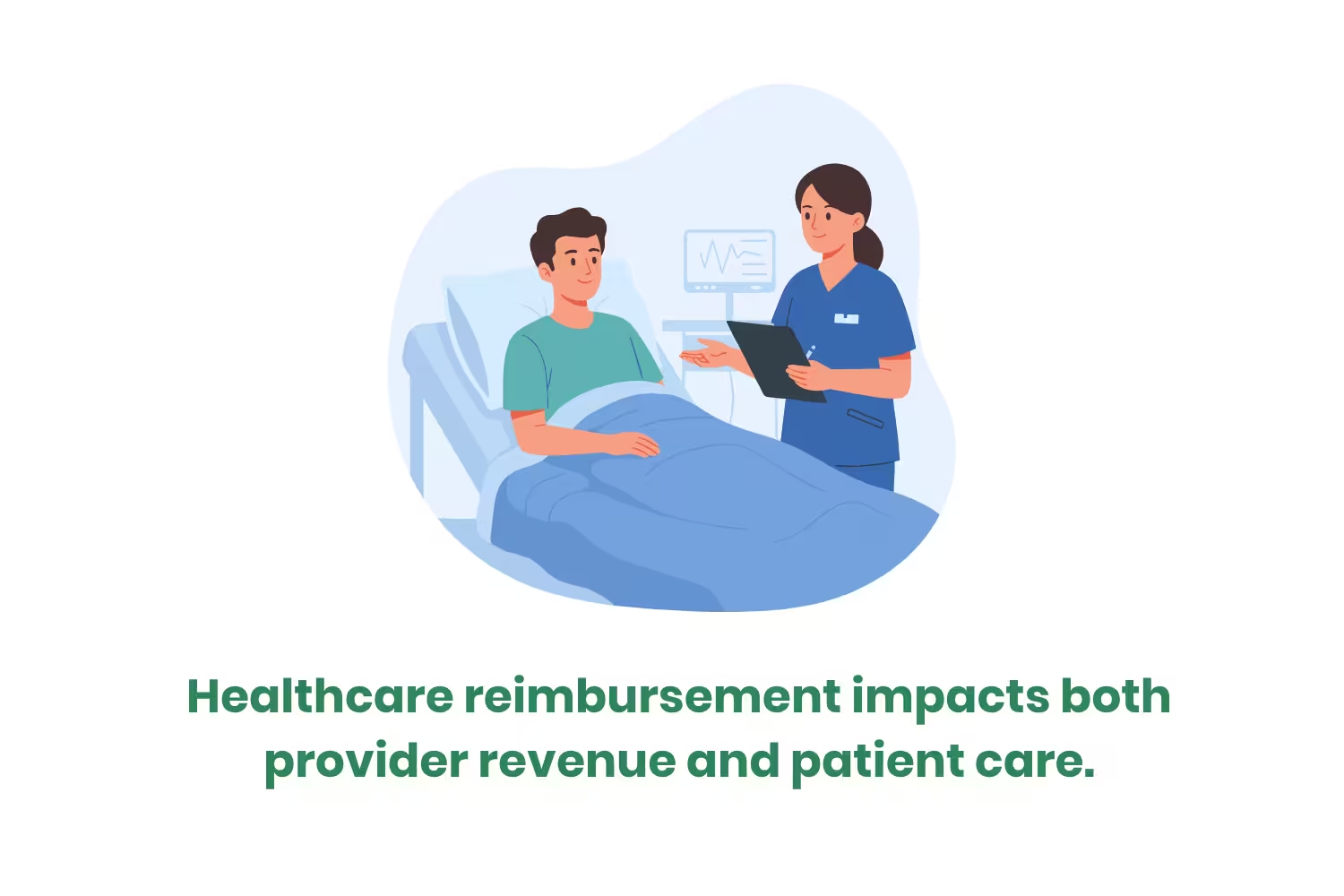
How Do Insurance Companies and Medicare Affect Reimbursement Rates?
Both insurance companies and Medicare significantly influence industry-wide reimbursement rates. Commercial insurers negotiate payment terms based on provider specialty, location, patient population, and network agreements. Meanwhile, Medicare frequently establishes benchmark rates that private insurers use as reference points.
The rise of programs tied to the affordable care act and broader aca reforms also accelerated the industry’s transition toward performance-driven payment systems. Today, providers are increasingly rewarded for improving patient outcomes, reducing unnecessary utilization, and delivering more efficient care.
How Does Reimbursement Impact Healthcare Costs and Preventive Care?
The structure of healthcare reimbursement directly affects overall healthcare costs, care accessibility, and provider decision-making.
Traditional reimbursement systems often rewarded volume, meaning providers earned more by delivering additional procedures and appointments. In contrast, newer payment models place greater emphasis on preventive care, long-term wellness, and coordinated treatment planning.
When reimbursement structures prioritize prevention and chronic disease management, healthcare organizations often experience lower readmission rates, improved patient satisfaction, and reduced long-term medical costs. These models are designed to encourage better quality of care while controlling spending across the healthcare system.
How Does Fee-for-Service Reimbursement Work and What Are Its Effects?
Among all types of healthcare reimbursement models, fee-for-service remains one of the most widely used structures.
Under this system, providers receive payment separately for every treatment, consultation, procedure, or diagnostic test performed.

What Is Fee-for-Service and How Does It Influence Healthcare Providers' Behavior?
In a fee-for-service or ffs model, every healthcare activity generates a separate reimbursement opportunity. Office visits, imaging procedures, lab work, surgeries, and follow-up appointments are all billed individually.
Because providers are compensated based on volume, critics argue the model can unintentionally encourage organizations to become incentivized to offer more services. This structure may contribute to higher utilization rates and increased healthcare costs, especially when providers perform unnecessary medical procedures that may not significantly improve patient health.
Despite these concerns, many providers continue using fee-for-service because it offers familiar workflows, predictable reimbursement structures, and flexibility in patient treatment decisions.
How Do Fee-for-Service Reimbursement Rates Get Set by Insurers and Medicare?
Under fee-for-service, insurers establish fee schedules that determine how much providers receive for specific procedures or treatments. These reimbursement rates are influenced by geographic location, provider specialty, procedure complexity, payer contracts, and government regulations.
Medicare relies on standardized coding systems and national fee schedules, while private insurers often negotiate custom payment arrangements with provider organizations.
Because reimbursement depends heavily on documentation accuracy, providers must prioritize effective billing and coding, complete documentation, and timely claims processing to avoid payment delays and denials.
What Are the Pros and Cons of Fee-for-Service for Quality Care and Healthcare Costs?
One major advantage of fee-for-service is its simplicity. Providers can deliver care without many restrictions on treatment decisions, and reimbursement structures are generally easier to understand and administer.
However, the model also creates challenges. Since revenue increases with service volume, healthcare organizations may focus more heavily on quantity rather than outcomes. This can increase administrative burden, contribute to rising healthcare costs, and create fragmented care experiences for patients.
As healthcare systems continue evolving, many organizations are exploring alternative payment structures that place greater emphasis on efficiency, coordination, and long-term patient wellness.
What Is Capitation and How Does Capitation Reimbursement Differ From Other Models?
Capitation is a reimbursement structure where providers receive a predetermined payment for managing a patient population over a defined period of time.
Unlike fee-for-service, providers are not paid based on the number of visits or procedures performed.
What Does Capitation Reimbursement Mean for Healthcare Professionals and Providers?
Under capitation reimbursement, providers receive a fixed amount per patient regardless of how often that patient receives care. This set amount per patient is designed to cover a broad range of healthcare services over a monthly or annual period.
For many healthcare professionals, this changes how patient care is managed. Since revenue is not tied to service volume, providers are encouraged to focus more heavily on prevention, chronic disease management, and operational efficiency.
Many managed care organizations use capitation models because they help create more predictable spending patterns while promoting coordinated care delivery.
How Is Amount Per Patient Determined Under Capitation and Capitation Reimbursement?
The amount per patient under capitation reimbursement depends on several factors, including age, geographic region, health status, and the presence of chronic conditions.
In some arrangements, providers receive a lump sum payment intended to cover all necessary care for a patient population during a specific timeframe. This shifts more financial responsibility onto providers, making efficient care management critically important.
Organizations that successfully manage patient populations under capitation often invest heavily in preventive medicine, analytics, and patient engagement initiatives.
How Does Capitation Affect Preventive Care and the Episode of Care Approach?
Because providers are not compensated based on treatment volume, capitation strongly supports preventive care efforts and long-term health management.
Healthcare organizations operating under this model often focus on reducing hospitalizations, identifying health risks earlier, and improving coordination across the entire episode of care. When implemented effectively, capitation reimbursement can improve patient outcomes, strengthen access to care, and reduce unnecessary utilization.
However, providers must carefully balance cost management with maintaining high-quality care, since under-treatment can create compliance concerns and patient dissatisfaction.
How Do Bundled Payment and Value-Based Reimbursement Compare to Traditional Models?
Healthcare reimbursement continues shifting toward models that reward efficiency and measurable health improvements instead of service volume alone.
Two of the most important alternatives are bundled payment systems and value-based reimbursement models.

What Is a Bundled Payment and How Does It Change Billing for an Episode of Care?
A bundled payment model provides providers with a single payment covering all treatment related to a specific condition or episode of care.
Instead of billing separately for every procedure or appointment, providers receive one combined reimbursement that may include hospital treatment, physician services, rehabilitation, and related outpatient care.
This model encourages collaboration between providers because reimbursement is tied to the overall success and efficiency of the patient’s treatment journey.
What Is Value-Based Reimbursement and How Does It Reward Quality Care?
Value-based reimbursement ties compensation to performance metrics rather than simply paying for service volume.
Under value-based systems, providers may receive financial incentives for improving patient outcomes, reducing readmissions, increasing patient satisfaction, and delivering stronger quality of care.
Rather than rewarding quantity alone, this approach prioritizes high-quality and cost-effective treatment delivery. Many healthcare systems view value-based reimbursement as a long-term strategy for improving healthcare sustainability while reducing unnecessary spending.
How Do Bundled Payment and Value-Based Models Impact Reimbursement Rates and Healthcare Costs?
Both bundled payment and value-based reimbursement models are designed to improve efficiency and lower overall healthcare costs.
By encouraging care coordination and discouraging duplicate or unnecessary services, these models can create more predictable spending patterns and better patient experiences. However, providers often need advanced analytics, stronger documentation processes, and improved operational infrastructure to succeed under these reimbursement structures.
Organizations transitioning into these models must also prepare for increased payer oversight, compliance reviews, and potential audit activity tied to performance metrics and reimbursement eligibility.
How Do Insurance Reimbursements, Medicare, and Medicaid Interact With Provider Billing?
Healthcare organizations must coordinate with multiple payer types while navigating highly detailed reimbursement requirements.
How Do Insurance Reimbursements Work With Hospital and Healthcare Provider Billing?
After treatment is completed, providers submit claims documenting diagnoses, procedures, and supporting records. Successful insurance reimbursements depend heavily on accurate coding, complete documentation, and efficient claims submissions.
Even small errors in billing and coding can trigger delayed payments or claim denial outcomes. As payer requirements continue becoming more complex, providers increasingly rely on automation and revenue cycle technology to improve reimbursement accuracy and reduce administrative burden.
What Are the Differences Between Medicare, Medicaid, and Private Insurance Reimbursements?
Medicare primarily serves older adults and individuals with qualifying disabilities, while Medicaid supports many low-income patients and families. Commercial insurers operate independently and negotiate contracts directly with providers.
Programs such as Medicare advantage further complicate reimbursement because they combine government-funded benefits with private insurance administration.
Each payer category uses different reimbursement methodologies, compliance standards, and approval processes, making payer management one of the most important operational functions in healthcare finance.
How Can Healthcare Professionals Optimize Reimbursement From Insurance Companies and Government Payers?
Improving reimbursement performance requires providers to focus on documentation accuracy, payer communication, and operational efficiency.
Organizations that prioritize strong coding practices, faster submitting claims, and proactive denial prevention strategies are often better positioned to improve cash flow and reduce administrative waste. Effective reimbursement management also helps support long-term financial stability while ensuring fair compensation for providers and clinical staff.
How Should Providers Choose Between Different Types of Healthcare Reimbursement Models?
Every reimbursement structure creates different financial incentives, operational risks, and patient care priorities.
What Factors Should Healthcare Providers Consider When Evaluating Reimbursement Models?
When evaluating different types of healthcare reimbursement, providers should consider patient population complexity, financial stability, technology infrastructure, compliance capabilities, and staffing resources.
Organizations with strong analytics and care coordination systems may perform well under value-based or capitation arrangements, while smaller practices may continue relying more heavily on traditional fee-for-service reimbursement.
How Do Reimbursement Models Affect Revenue Management and Medical Reimbursement Strategies?
Different reimbursement systems influence nearly every aspect of provider operations, including staffing, financial forecasting, compliance management, and patient engagement strategies.
Successful medical reimbursement planning requires balancing operational sustainability with delivering excellent patient care. Providers increasingly use technology platforms and automation tools to improve revenue cycle performance, reduce denials, and strengthen financial reporting.
How Can Providers Transition From Fee-for-Service to Value-Based or Capitation Reimbursement?
Transitioning away from traditional fee-for-service systems often requires major operational changes.
Healthcare organizations typically begin by strengthening data analytics capabilities, improving care coordination programs, enhancing patient engagement strategies, and modernizing revenue cycle operations. Educating clinical teams about changing reimbursement incentives is also critical for long-term success.
Although the transition can be challenging, providers that adapt successfully are often better positioned to improve financial sustainability while continuing to deliver strong patient-centered care.
Conclusion
The future of healthcare depends heavily on how organizations adapt to evolving types of healthcare reimbursement models.
While traditional fee-for-service systems remain common, newer approaches such as capitation, bundled payment, and value-based reimbursement are transforming how providers manage patient care and financial performance. These models aim to improve efficiency, reduce unnecessary spending, and encourage stronger long-term health outcomes.
For modern healthcare providers, understanding how reimbursement works is essential for maintaining profitability, improving operational performance, and continuing to deliver high-quality care in an increasingly complex healthcare environment.
Emphasize your product's unique features or benefits to differentiate it from competitors
In nec dictum adipiscing pharetra enim etiam scelerisque dolor purus ipsum egestas cursus vulputate arcu egestas ut eu sed mollis consectetur mattis pharetra curabitur et maecenas in mattis fames consectetur ipsum quis risus mauris aliquam ornare nisl purus at ipsum nulla accumsan consectetur vestibulum suspendisse aliquam condimentum scelerisque lacinia pellentesque vestibulum condimentum turpis ligula pharetra dictum sapien facilisis sapien at sagittis et cursus congue.
- Pharetra curabitur et maecenas in mattis fames consectetur ipsum quis risus.
- Justo urna nisi auctor consequat consectetur dolor lectus blandit.
- Eget egestas volutpat lacinia vestibulum vitae mattis hendrerit.
- Ornare elit odio tellus orci bibendum dictum id sem congue enim amet diam.
Incorporate statistics or specific numbers to highlight the effectiveness or popularity of your offering
Convallis pellentesque ullamcorper sapien sed tristique fermentum proin amet quam tincidunt feugiat vitae neque quisque odio ut pellentesque ac mauris eget lectus. Pretium arcu turpis lacus sapien sit at eu sapien duis magna nunc nibh nam non ut nibh ultrices ultrices elementum egestas enim nisl sed cursus pellentesque sit dignissim enim euismod sit et convallis sed pelis viverra quam at nisl sit pharetra enim nisl nec vestibulum posuere in volutpat sed blandit neque risus.
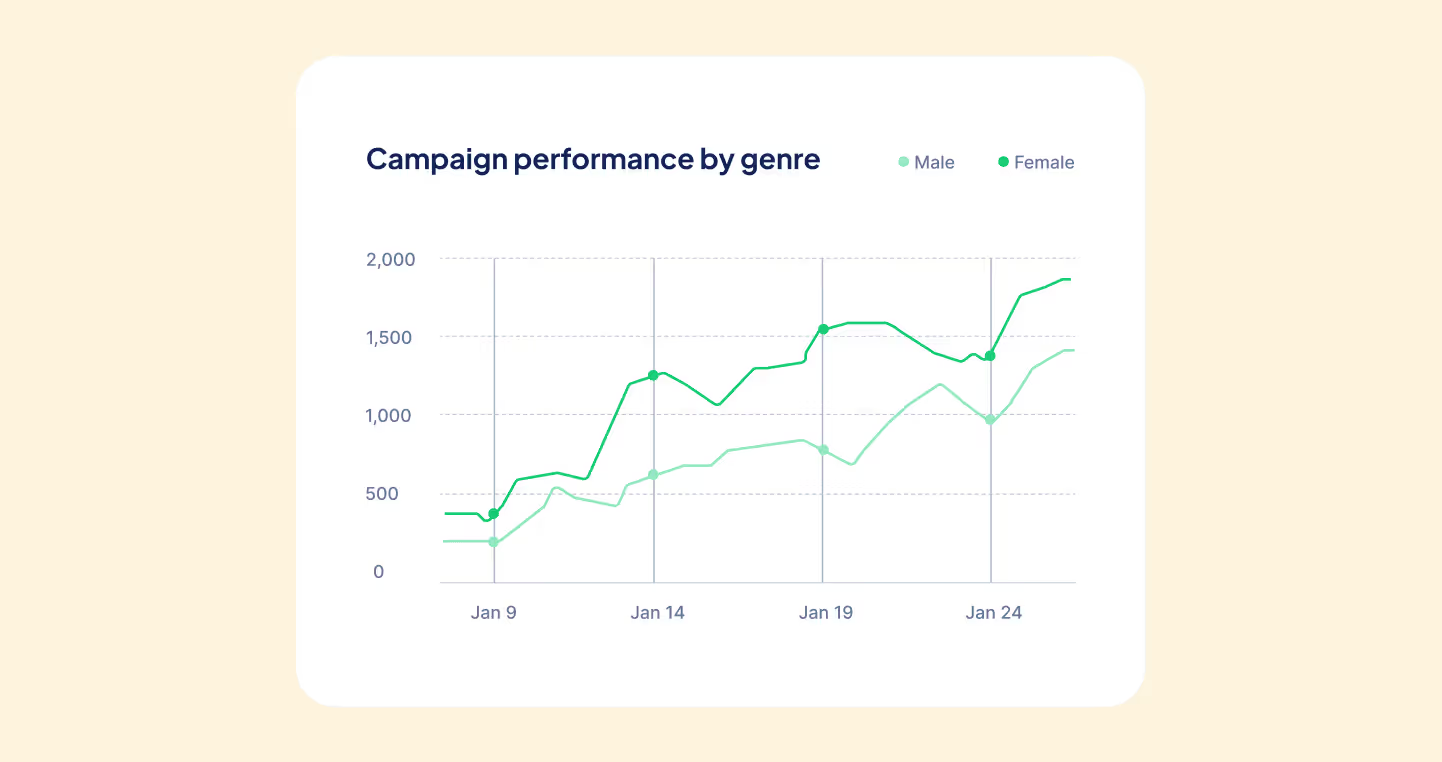
Use time-sensitive language to encourage immediate action, such as "Limited Time Offer
Feugiat vitae neque quisque odio ut pellentesque ac mauris eget lectus. Pretium arcu turpis lacus sapien sit at eu sapien duis magna nunc nibh nam non ut nibh ultrices ultrices elementum egestas enim nisl sed cursus pellentesque sit dignissim enim euismod sit et convallis sed pelis viverra quam at nisl sit pharetra enim nisl nec vestibulum posuere in volutpat sed blandit neque risus.
- Pharetra curabitur et maecenas in mattis fames consectetur ipsum quis risus.
- Justo urna nisi auctor consequat consectetur dolor lectus blandit.
- Eget egestas volutpat lacinia vestibulum vitae mattis hendrerit.
- Ornare elit odio tellus orci bibendum dictum id sem congue enim amet diam.
Address customer pain points directly by showing how your product solves their problems
Feugiat vitae neque quisque odio ut pellentesque ac mauris eget lectus. Pretium arcu turpis lacus sapien sit at eu sapien duis magna nunc nibh nam non ut nibh ultrices ultrices elementum egestas enim nisl sed cursus pellentesque sit dignissim enim euismod sit et convallis sed pelis viverra quam at nisl sit pharetra enim nisl nec vestibulum posuere in volutpat sed blandit neque risus.
Vel etiam vel amet aenean eget in habitasse nunc duis tellus sem turpis risus aliquam ac volutpat tellus eu faucibus ullamcorper.
Tailor titles to your ideal customer segment using phrases like "Designed for Busy Professionals
Sed pretium id nibh id sit felis vitae volutpat volutpat adipiscing at sodales neque lectus mi phasellus commodo at elit suspendisse ornare faucibus lectus purus viverra in nec aliquet commodo et sed sed nisi tempor mi pellentesque arcu viverra pretium duis enim vulputate dignissim etiam ultrices vitae neque urna proin nibh diam turpis augue lacus.
![[ANSWERED] What is allowed amount in medical billing?](https://cdn.prod.website-files.com/67e2b8210878abcba6f91ae6/6a5a4d5faf15c04c136c5f87_WhatisAllowedAmountinMedicalBilling_726.avif)