
Pledge Thy Patient Loyalty: Where to Start
Patients feel frustrated with their experiences in healthcare. How do you combat their frustration? By building loyalty.

When you hear the word “loyalty” thrown around in the corporate world, what do you think of?
The first thing that comes to my mind is people who only buy certain things from one company. You probably know someone who only buys a specific brand of clothing or purse. They won’t even touch or look at anything other than the company they believe provides the best product.
Maybe you’re one of those people, which is fine.
Now, let’s switch gears here. Do you know someone who’s loyal to a healthcare organization? They wouldn’t go anywhere else to seek treatment, maybe they’ve even written a few glowing testimonials about their doctor.
I imagine the list of people that came to mind off of the top of your head answering that question is much smaller, if it exists at all. The reality is that it’s much harder to stay loyal to a specific doctor or practice than it is to a consumer goods corporation.
Think about it, after you buy something at a retail store they don’t have to contact your insurance, make sure their item is “covered” and OK for you to purchase. Likewise, the costs associated with healthcare services are usually much higher than that of a piece of clothing.
But, beyond the costs associated with healthcare, patients are much less satisfied with the services they receive. 75% of frequent practice visitors feel frustrated with their experience.
If patient frustration is at all related to the consumer world, then one-third of them would switch their provider after one bad experience.
Sure, all of these statistics don’t reflect well on the healthcare industry. I’m merely pointing out that there’s a problem. If you find ways to solve this problem, you’ll thrive as a practice.
How do you solve it? Building patient loyalty.
Understand The Reality
Organizations love those who are most loyal to them because 65% of their business comes from existing customers.
It’s safe to assume that loyal patients contribute similar percentages to healthcare facilities, right?
No. The reality is much different and more fickle than the business-to-consumer landscape.
According to an Accenture study, patients are about as likely to switch their provider as they are their cellphone carrier. To put that into perspective, think about your relationship with your own carrier. Can you name one employee at the store you went to when you bought your phone? It’s a much less personal relationship yet most patients view them similarly.
Another reality is that there are two additional types of loyalty; latent and spurious. Latent falls outside the scope of this blog post, but we’re going to focus on spurious.
Spurious loyalty happens when clients have what seems like positive attitudes toward a company but are just as likely to purchase similar products from competitors.
A study in the Journal of Medical Marketing found that patients may be loyal enough to come back to an organization, but will switch after just one negative experience. This directly contradicts KPMG’s commercial space findings that 46% of consumers will remain loyal after a bad experience. Thus, preferences within healthcare seem spurious.
So, what’s the point of putting any effort or attention toward this?
It’s not all bad. About 60% of patients are loyal to their healthcare provider. The point after all of this “negative” information is to help you stay true to turning your clients into your advocates and that doing so is only possible by avoiding superficial measurements

Find Your Biggest Supporters
What’s the cost of losing a patient because they left your practice? The U.S. Census Bureau places the average lifetime value of an individual healthcare consumer at $1.4 million. In other words, every time you lose one of your patients you’re losing a ton of revenue.
If you’ve been in business for a few years, odds are that you have at least a handful of patients who are already loyal to your practice. These individuals are your starting point when you’re trying to determine where to begin.
You can use them as a baseline to define what loyalty is to your practice. But, how do you find them?
Maybe your clients are tech-savvy. If that’s the case, then you’ll find your biggest advocates on review boards writing about how great your business is and how everyone should make an appointment with you.

Not every advocate of your organization will go out of their way to write paragraphs about you, though, maybe that’s not their style. How do you find those clients who aren’t as open about their love for your services?
There are two alternative ways to conduct your research.
First, you could look through your electronic health record (EHR) system. Look for those patients that have made multiple appointments with you over the course of a couple of years. Second, ask them about their experience the next time a patient comes in for their visit. You could do this with a satisfaction survey or from a direct face-to-face question.
It’s important to figure out who from your client base is already loyal to you so that you can use them to define what it means to your business.
Maybe they don’t write public reviews about you or recommend you to their social circles, they just show up consistently and have been for years. They’re still bringing a ton of value to you and you could always encourage them to be more outspoken. You just have to figure out who they are first.
Look for Easy Ways to Boost Satisfaction
In order to thrive as a healthcare entity, you need to make sure that your clients stay. Luckily, it’s not as hard as it seems.
That’s because there’s a direct correlation between their loyalty to you and their satisfaction with you.
Think about the last time you went to the doctor.
If you’re like the majority of patients, you probably delayed scheduling your appointment as long as you could. But, once the day finally came, what feelings came over you?
Most likely, you weren’t overjoyed to talk to an enthusiastic office manager, wait in a beige-colored room, stare at outdated art on the wall and rows of paper records (if they’re outdated) for an hour before you get called into your exam room.
Imagine how you’d feel walking into a comfortable office with modern lounge furniture, easy access to WIFI and an area to make your favorite hot beverage. All three of these adjustments quickly change your entire perception of your appointment.
Since patients spend the majority of their time in the waiting room, adjustments to make their stay more comfortable boost their attitude towards your practice. In fact, environment landed among the top three most important factors in improving patient satisfaction.
Second, provide a memorable and streamlined experience.
Have you ever gone to a restaurant that used a lot of technology? You get there and put your name on the waiting list, they ask for your phone number and they’ll text you how long the wait is, making it easy for you to do other things to occupy your time.
You sit down at your table and the menu isn’t a booklet, it’s a QR code that you scan with your phone. Sometimes they even have tablets on the tables that record orders so that you can check out whenever you want.
These subtle details make enough of an impression on you that you remember exactly where they happened.
Prescribe Personalization
The medical industry continues to shift toward a value-based approach. Entities receive payment based on results. Thus, the providers hand their “power” over to their patients.
In order to stand out in this model, you’ll need to make your services personalized to your clients. Providing a sense of individuality.
What does this look like?
- Quality Care: An experience that promotes a healthier lifestyle leading to fewer visits, procedures, etc.
- Scheduling: Having a process in place that’s user-friendly and provides adequate availability.
- Appointment Reminders: Consistent and personalized reminders to ensure that neither party forgets about their obligations while allowing for cancellations and rescheduling.
- Feedback Surveys: Sent questionnaires asking for honest and straightforward feedback before, during and after a session.
- Healthcare Record Access: Available upon request and kept on a HIPAA compliant, secured system.
Each of the factors listed above provide an experience that puts the patient first.
Make Connection Easy
Trust builds loyalty and that can only happen if there’s a strong relationship between yourself and your client.
When I say building a relationship, I’m not talking about a cold, professional one. If that were the case, this wouldn’t be a section within this blog post because most doctors probably already have those relationships.
Here’s the bottom line, these relationships don’t work as effectively anymore.
83% of patients want their doctors to text them. Is that something you do? It doesn’t have to be an overly-friendly conversation where you ask what their plans are this evening. Maybe the client you’re messaging has a chronic illness that requires a prescription and you’re checking in on how they’re doing.
Have you ever sent your clients a happy birthday card or message before? I bet most doctors don’t do that. But, imagine how it’d make them feel coming from the professional who helps them with their health.
Of course, there are boundaries that should exist between yourself and those that come in for their appointments.
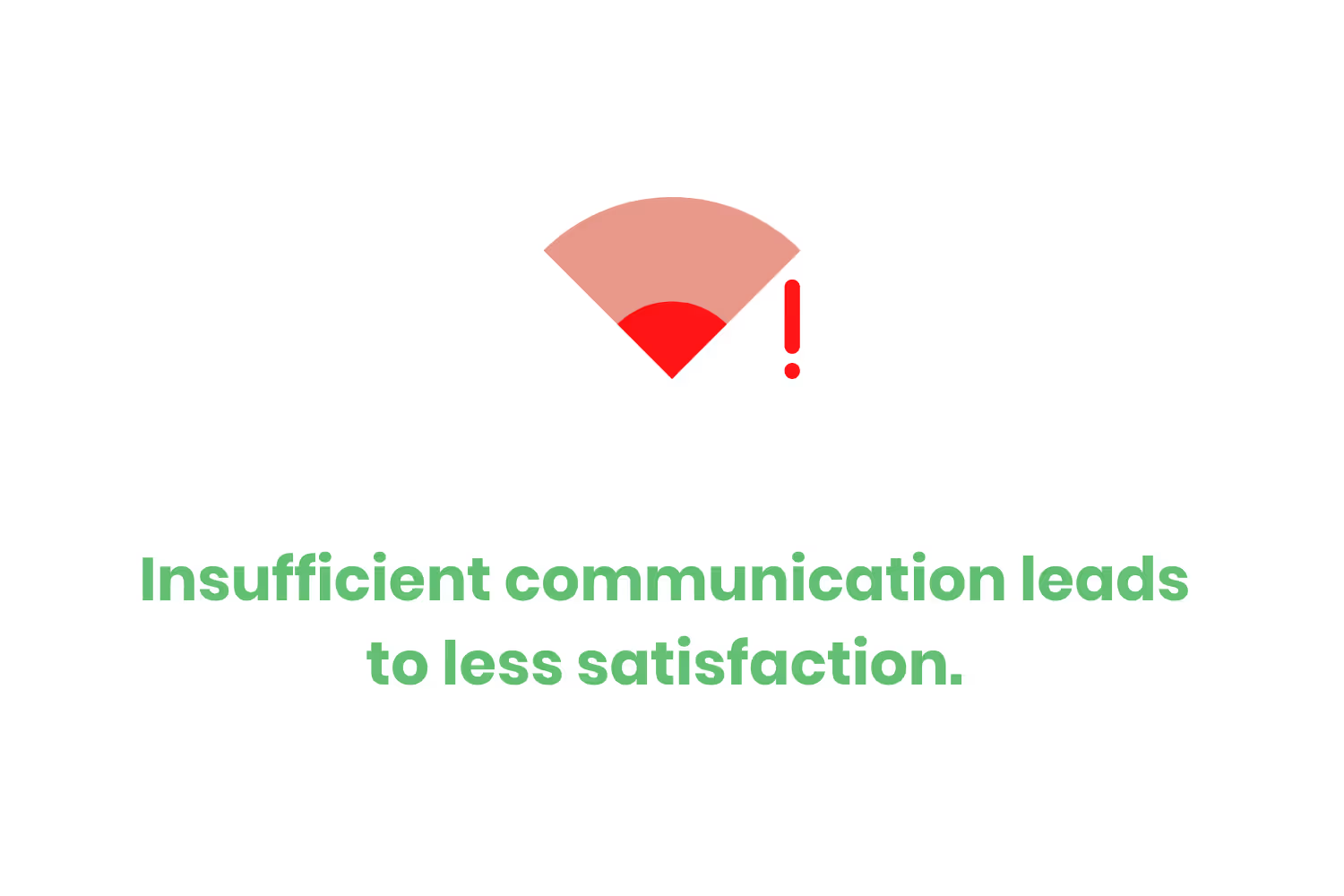
Just know that studies show that insufficient communication leads to less satisfaction. We know what that leads to; an unloyal “fanbase”.
Conclusion
Odds are, patients aren’t going to be more loyal to their doctor than their favorite technology company.
That’s a hard statement, sure, but it’s not an overreaction. There’s just too much involved with healthcare, making it impossible to influence your relationship with your patients fully. But that doesn’t mean the steps you’re currently taking or thinking about implementing won’t have an impact.
The patient landscape is changing without a doubt. So, you have no choice but to implement ways to build loyalty with those who come into your office. Just focus on the efforts that work instead of those that are superficial.
Emphasize your product's unique features or benefits to differentiate it from competitors
In nec dictum adipiscing pharetra enim etiam scelerisque dolor purus ipsum egestas cursus vulputate arcu egestas ut eu sed mollis consectetur mattis pharetra curabitur et maecenas in mattis fames consectetur ipsum quis risus mauris aliquam ornare nisl purus at ipsum nulla accumsan consectetur vestibulum suspendisse aliquam condimentum scelerisque lacinia pellentesque vestibulum condimentum turpis ligula pharetra dictum sapien facilisis sapien at sagittis et cursus congue.
- Pharetra curabitur et maecenas in mattis fames consectetur ipsum quis risus.
- Justo urna nisi auctor consequat consectetur dolor lectus blandit.
- Eget egestas volutpat lacinia vestibulum vitae mattis hendrerit.
- Ornare elit odio tellus orci bibendum dictum id sem congue enim amet diam.
Incorporate statistics or specific numbers to highlight the effectiveness or popularity of your offering
Convallis pellentesque ullamcorper sapien sed tristique fermentum proin amet quam tincidunt feugiat vitae neque quisque odio ut pellentesque ac mauris eget lectus. Pretium arcu turpis lacus sapien sit at eu sapien duis magna nunc nibh nam non ut nibh ultrices ultrices elementum egestas enim nisl sed cursus pellentesque sit dignissim enim euismod sit et convallis sed pelis viverra quam at nisl sit pharetra enim nisl nec vestibulum posuere in volutpat sed blandit neque risus.
Use time-sensitive language to encourage immediate action, such as "Limited Time Offer
Feugiat vitae neque quisque odio ut pellentesque ac mauris eget lectus. Pretium arcu turpis lacus sapien sit at eu sapien duis magna nunc nibh nam non ut nibh ultrices ultrices elementum egestas enim nisl sed cursus pellentesque sit dignissim enim euismod sit et convallis sed pelis viverra quam at nisl sit pharetra enim nisl nec vestibulum posuere in volutpat sed blandit neque risus.
- Pharetra curabitur et maecenas in mattis fames consectetur ipsum quis risus.
- Justo urna nisi auctor consequat consectetur dolor lectus blandit.
- Eget egestas volutpat lacinia vestibulum vitae mattis hendrerit.
- Ornare elit odio tellus orci bibendum dictum id sem congue enim amet diam.
Address customer pain points directly by showing how your product solves their problems
Feugiat vitae neque quisque odio ut pellentesque ac mauris eget lectus. Pretium arcu turpis lacus sapien sit at eu sapien duis magna nunc nibh nam non ut nibh ultrices ultrices elementum egestas enim nisl sed cursus pellentesque sit dignissim enim euismod sit et convallis sed pelis viverra quam at nisl sit pharetra enim nisl nec vestibulum posuere in volutpat sed blandit neque risus.
Vel etiam vel amet aenean eget in habitasse nunc duis tellus sem turpis risus aliquam ac volutpat tellus eu faucibus ullamcorper.
Tailor titles to your ideal customer segment using phrases like "Designed for Busy Professionals
Sed pretium id nibh id sit felis vitae volutpat volutpat adipiscing at sodales neque lectus mi phasellus commodo at elit suspendisse ornare faucibus lectus purus viverra in nec aliquet commodo et sed sed nisi tempor mi pellentesque arcu viverra pretium duis enim vulputate dignissim etiam ultrices vitae neque urna proin nibh diam turpis augue lacus.
.avif)