

What is a Medical Billing Clearinghouse in Healthcare?
Medical billing clearinghouses are vital role in processing and managing thousands of patients' insurance claims and billing. So, let's see what a medical billing clearinghouse is and the benefits that it provides.

Medical billing clearinghouses are crucial for healthcare providers. They help with managing patient data, insurance claims, and efficient billing. In modern healthcare billing, this often includes handling electronic remittance. As well as coordinating billing services. But what actually is a medical clearinghouse?
Why don't I just start with what a clearinghouse is, and then we can move on to the medical aspect.
A clearinghouse is an organization that collects and distributes something, usually information.
It acts as an intermediary and helps facilitate transactions by managing remittance workflows. This means they have the resources to:
- Distribute payments.
- Enforce security measures.
- Monitor transactions and statements.
We need clearinghouses to make transactions smoother and according to plan. It ensures all elements of a deal or transaction follow the rules and there's no mischief going on. It catches mistakes early on in the process to avoid backtracking. Clearinghouses exist in many different industries. They essentially make everything flow easier, especially in business-to-business transactions.
Medical billing clearinghouses play a vital role in processing and managing insurance claims. These clearinghouses help providers get approved for insurance claims. Leading to more revenue overall.
This also entails what we call claim scrubbing and denial management. We’ll talk more about that later.
What is a Healthcare Clearinghouse?
A healthcare clearinghouse is the middleman between providers and insurance companies. It acts as a bridge between healthcare providers and health plans. They make sure there are no mistakes during the billing process.
It helps providers process healthcare claims electronically. Billing correctly and efficiently, streamlining the overall billing process.
Front-end staff schedules several appointments a day. With the large volume of patients they tend to, it opens up room for mistakes. Especially when you factor in that patients might use different insurance providers.
A clearinghouse offers a way to review for errors before you submit claims.
HIPAA Compliance and Medical Claims Clearinghouses
Healthcare clearinghouses tend to do more than a normal clearinghouse. There are protocols and security measures to ensure protected health information (PHI).
A clearinghouse might handle health information received from another organization. In this case, they would be considered a business associate or covered entity, depending on its role.
Find a clearinghouse that is compliant with HIPAA regulations and requirements. Regulations ensure clearinghouses protect PHI and health records while maintaining compliance with HIPAA.
Some of these regulations include required HIPPA training, printing regulations, and multiple-step authentication.
Compliance helps gain the trust of stakeholders, providers, payers, and patients. It also protects them from HIPAA breaches while ensuring compliance with HIPAA regulations.
Why Do Healthcare Providers Need A Clearinghouse Process?
Medical billing clearinghouses are important for the provider's profits. The provider is the doctor or medical professional that is administering care.
Denied insurance claims are a common issue in the revenue cycle of medical practices.
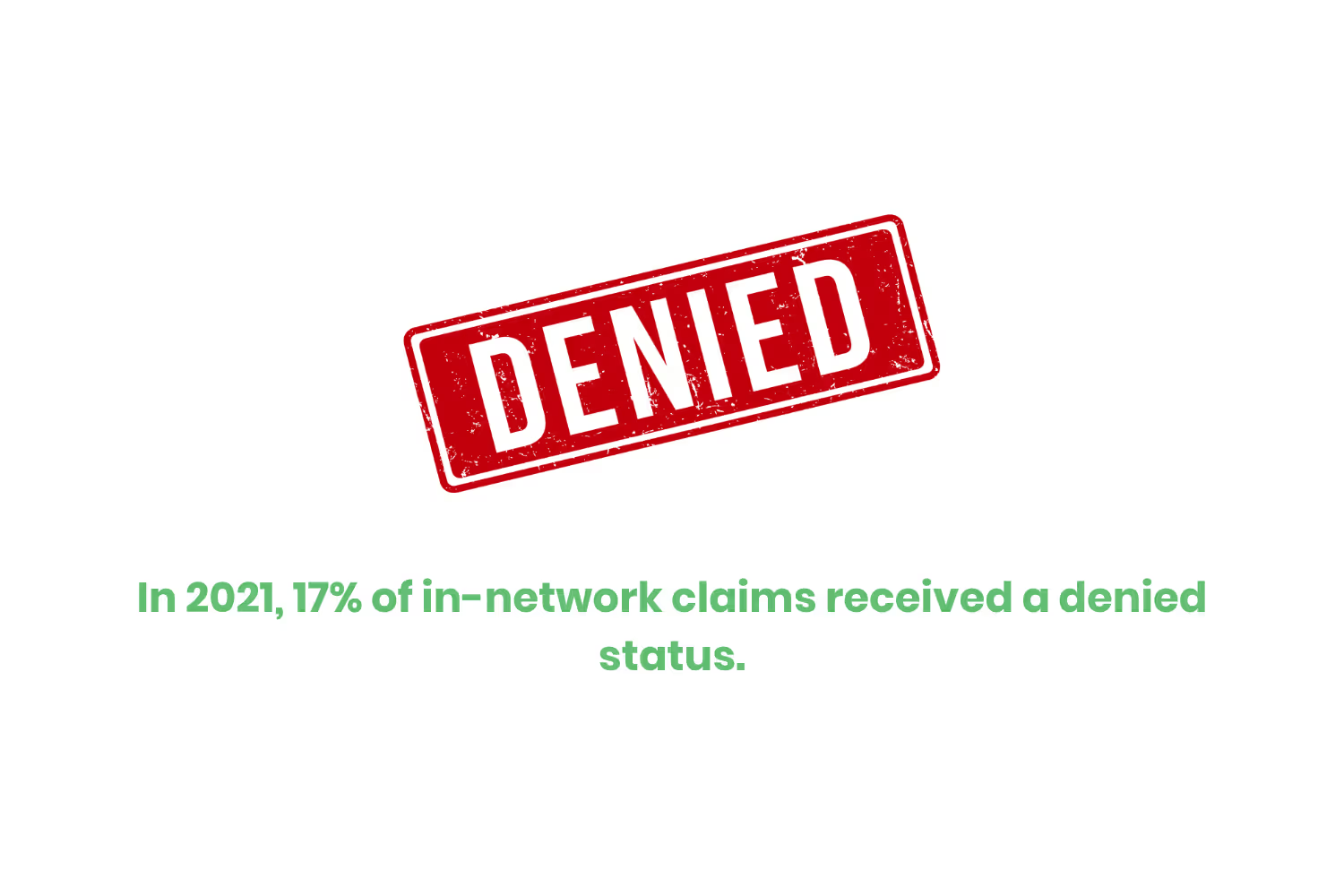
In 2021, 17% of in-network claims received a denied status.
There was $10.6 billion of lost revenue as a result of denied claims in 2022. On average, hospitals lost $5 million of their total revenue due to denied claims.
Looking at it on a larger scale makes clearinghouses seem more important right?
A denied claim is bad news. And they happen for many reasons. It could be the lack of patient information. Maybe a duplicate claim or service, a service that is not covered by the insurance, or it can be as simple as a spelling error.
Denials are categorized in codes. Healthcare insurance companies assign these codes to the reason claims get denied. This makes it easier to decipher the problem and what steps are necessary to get the claim approved. It speeds up the process for the insurance provider by eliminating the need to write specific descriptions for each claim.
A denied claim means a delay in the provider's profit. You wouldn't want to work for free right? Didn’t think so. This is why a clearinghouse is so important.
If a claim gets denied, it needs correction and goes through the approval process again. But, this process can take anywhere from 15 to 45 days. If a claim comes back in a denied status, even once, the provider will miss a significant portion of their paycheck for at least a month.
Denied claims result in a revenue loss, even if they’re approved upon resubmission. Besides, handling denied claims consumes more time and energy compared to getting them approved the first time. So you might as well do it right the first time.
The Claims Process and How Clearinghouses in Healthcare Help
Now that we defined a medical billing clearinghouse and why we need it, let's look at how it works.
Calling to schedule an appointment is the first step in the revenue cycle. Scheduling usually takes place in a practice management (PM) system.
Anyway, a medical billing clearinghouse begins its process at the point of entry for patient data. Usually, a solid medical billing clearinghouse will integrate with your PM system (we do that). The healthcare providers enter the patient's name, date of birth, treatment details, and other necessary information into the system.
After data entry, a clearinghouse checks to make sure the patient's information is accurate and if their insurance will cover the appointment at all. The industry refers to this process as checking eligibility.
Once the appointment or procedure occurs, the clearinghouse creates a claim using the information from the patient management system. This is usually in a standard format that’s approved by medical insurance companies.
At this point, the clearinghouse will then scrub the claim. It will find any errors beforehand and correct them at this stage. This correction could be a typing error or an incorrect code that’s fixable by the clearinghouse personnel.
However, missing provider or patient information might need correction from the healthcare provider or the provider's office.
Once everything gets corrected, it’s transferred to the patient’s insurance company. If the claim receives approval, the insurance provider will notify the clearinghouse who will then notify the healthcare provider.
This communication is key.
The clearinghouse then processes and calculates what the patient owes and creates a statement. Insurance usually covers anywhere from 60%-90% of the bill, leaving the payer or patient to fund the rest.
The statement gets sent electronically or by mail. Within the patient's statement, they can see the amount due, the services provided, and what the insurance covered.
Maybe an example of a statement pic or something?
After the statement goes out, the patient then has to pay their outstanding balance. If the payment is overdue the patient risks their balance getting sent to collections.
If a patient has an outstanding medical bill, they’ll eventually hear from debt collecting agencies. Approximately one in five households within the US faces challenges when paying off medical debt.
Failure to pay medical bills can lead to serious consequences. It can impact patient credit reports and potentially lead to legal action. This emphasizes the financial burden that medical expenses have on individuals across the country, but that is a topic for another day.
Why Do Payers Deny Claims in the Billing Process?
There are two types of denials, hard denials and soft denials.
Though they are both denials, it’s better to get a soft denial because this means you’re missing data or you’re lacking documentation. You have the opportunity to recover the lost revenue by correcting the original mistakes.
A hard denial, on the other hand, means the insurance company outright refuses to pay the claim. A hard denial usually occurs when an insurance company doesn't cover the services provided.
These types of denials are usually written off as losses because there’s no way to recover revenue from them. Think of it as totaling a car, it would take more energy to fix than what it’s worth.
What is Claim Scrubbing?
Claim scrubbing is the validation checks the clearinghouse performs before sending the claim to the insurance provider. There are checks before this step, but this is the last step that involves cleaning up information.
Once the corrections occur, it’s off to the insurance providers to get approved or, hopefully not, denied. If you’re not scrubbing properly you might have to rework the claim, which can take more time and effort than what it's worth.
Multiple claims go to the same insurance provider. To make handling all of the claims easier, they do what’s called batching and routing. This is pretty self-explanatory, but batching and routing is the process of organizing the claims before they get routed to the appropriate insurance company.
What Did People Do Before Medical Billing Clearinghouses?
Before the invention of clearinghouses, healthcare providers had to manually submit and process all of their patient’s claims. This method was not only time-consuming for receptionists and providers, but it resulted in many mistakes. A lot of claims were only checked once which led to a lot of denials and inaccuracies.
We know how long processing claims take, imagine one claim getting denied two or three times. Now imagine several claims getting denied two or three times. This affects many people, but mainly the providers because they aren’t getting paid for months.
The invention of clearinghouses revolutionized claim submissions and claim verification through automation. This significantly reduced errors and simplified the workflow in healthcare billing. It also led to more claims getting approved!
This meant that providers were getting paid within 30 days, not after. The positive impact that clearinghouses had on the revenue cycle caused the industry to grow in popularity.
Medical Billing Clearinghouses Popularity
As the healthcare industry becomes more advanced electronically, so do the billing intricacies. This means it’s harder and harder for providers to keep up with all their patient's claims, and do them correctly. Clearinghouses are a modern necessity.
Doctors have very busy schedules and cannot keep up with the behind-the-scenes paperwork. The provider's job is to care for the patient and perform the necessary procedures for their well-being.
Have you ever waited for months to see your primary care doctor or dentist? I know I have. Now imagine if your doctor had to do hours and hours of paperwork after each patient. If this was part of their job description, you would never get that appointment.
Claim denials are becoming more and more of a problem. Healthcare facilities were seeing a 23% increase in claims denials from 2016 to 2020. Imagine 23% of your annual revenue gone. Yikes.
Now can you see how much of a necessity a medical billing clearinghouse is?
Choosing a Medical Billing Clearinghouse For You
Medical billing clearinghouses are essential for modern healthcare. They’re probably implemented at your doctor's office and you never even knew!
The healthcare industry is on track to becoming more digital. clearinghouses will play an even greater role. As technology advances, so should your medical billing software. Regardless if you’re a payer, provider, or just a patient, you’re a part of this cycle. Choosing the right billing software and clearinghouse in medical billing can make or break your business.
The best clearinghouses help you streamline workflows, reducing claim denials, and protect PHI. Investing in the right clearinghouse can help you stay financially healthy and worry-free!
Emphasize your product's unique features or benefits to differentiate it from competitors
In nec dictum adipiscing pharetra enim etiam scelerisque dolor purus ipsum egestas cursus vulputate arcu egestas ut eu sed mollis consectetur mattis pharetra curabitur et maecenas in mattis fames consectetur ipsum quis risus mauris aliquam ornare nisl purus at ipsum nulla accumsan consectetur vestibulum suspendisse aliquam condimentum scelerisque lacinia pellentesque vestibulum condimentum turpis ligula pharetra dictum sapien facilisis sapien at sagittis et cursus congue.
- Pharetra curabitur et maecenas in mattis fames consectetur ipsum quis risus.
- Justo urna nisi auctor consequat consectetur dolor lectus blandit.
- Eget egestas volutpat lacinia vestibulum vitae mattis hendrerit.
- Ornare elit odio tellus orci bibendum dictum id sem congue enim amet diam.
Incorporate statistics or specific numbers to highlight the effectiveness or popularity of your offering
Convallis pellentesque ullamcorper sapien sed tristique fermentum proin amet quam tincidunt feugiat vitae neque quisque odio ut pellentesque ac mauris eget lectus. Pretium arcu turpis lacus sapien sit at eu sapien duis magna nunc nibh nam non ut nibh ultrices ultrices elementum egestas enim nisl sed cursus pellentesque sit dignissim enim euismod sit et convallis sed pelis viverra quam at nisl sit pharetra enim nisl nec vestibulum posuere in volutpat sed blandit neque risus.
Use time-sensitive language to encourage immediate action, such as "Limited Time Offer
Feugiat vitae neque quisque odio ut pellentesque ac mauris eget lectus. Pretium arcu turpis lacus sapien sit at eu sapien duis magna nunc nibh nam non ut nibh ultrices ultrices elementum egestas enim nisl sed cursus pellentesque sit dignissim enim euismod sit et convallis sed pelis viverra quam at nisl sit pharetra enim nisl nec vestibulum posuere in volutpat sed blandit neque risus.
- Pharetra curabitur et maecenas in mattis fames consectetur ipsum quis risus.
- Justo urna nisi auctor consequat consectetur dolor lectus blandit.
- Eget egestas volutpat lacinia vestibulum vitae mattis hendrerit.
- Ornare elit odio tellus orci bibendum dictum id sem congue enim amet diam.
Address customer pain points directly by showing how your product solves their problems
Feugiat vitae neque quisque odio ut pellentesque ac mauris eget lectus. Pretium arcu turpis lacus sapien sit at eu sapien duis magna nunc nibh nam non ut nibh ultrices ultrices elementum egestas enim nisl sed cursus pellentesque sit dignissim enim euismod sit et convallis sed pelis viverra quam at nisl sit pharetra enim nisl nec vestibulum posuere in volutpat sed blandit neque risus.
Vel etiam vel amet aenean eget in habitasse nunc duis tellus sem turpis risus aliquam ac volutpat tellus eu faucibus ullamcorper.
Tailor titles to your ideal customer segment using phrases like "Designed for Busy Professionals
Sed pretium id nibh id sit felis vitae volutpat volutpat adipiscing at sodales neque lectus mi phasellus commodo at elit suspendisse ornare faucibus lectus purus viverra in nec aliquet commodo et sed sed nisi tempor mi pellentesque arcu viverra pretium duis enim vulputate dignissim etiam ultrices vitae neque urna proin nibh diam turpis augue lacus.


![[ANSWERED] What is allowed amount in medical billing?](https://cdn.prod.website-files.com/67e2b8210878abcba6f91ae6/6a5a4d5faf15c04c136c5f87_WhatisAllowedAmountinMedicalBilling_726.avif)